How Did We Get Here?
The controversy surrounding the Fox River Resort should not be viewed as an isolated local incident. For many, it appears to be another step in a much larger pattern: the gradual restructuring of land use, food production, energy policy, immigration, public health, and local governance under global agendas that weaken national sovereignty and local control. What may begin as a zoning dispute, a renewable energy project, a public-private development, or a sustainability initiative often points back to the same central question: Who is really shaping the future of our communities — the people who live there, or powerful national and international institutions pursuing a global vision? To understand why developments like Fox River Resort raise such deep concern, we must ask a broader question: How did we get here?
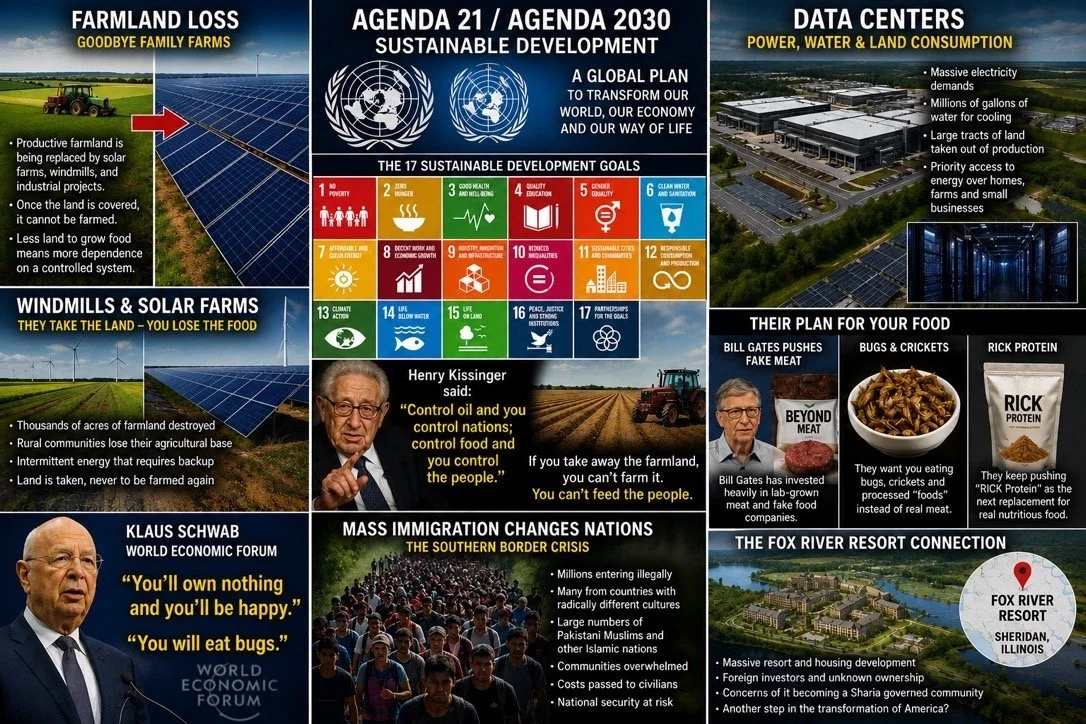
Agenda 2030, Sustainable Development, Food Security, Energy Policy, and National Sovereignty: A Critical Perspective
Many citizens have become increasingly concerned about the long-term implications of Agenda 21, Agenda 2030, the Sustainable Development Goals (SDGs), policies promoted by the United Nations, the World Health Organization (WHO), and influential global organizations such as the World Economic Forum (WEF).
While these organizations describe their goals as promoting sustainability, environmental stewardship, public health, and economic development, critics argue that the practical implementation of these policies may lead to unintended consequences that impact personal freedom, private property rights, food production, energy independence, and national sovereignty.
Farmland Conversion and Food Security
One concern centers around the rapid conversion of agricultural land into industrial uses such as:
Large-scale solar farms
Wind energy projects
Carbon sequestration projects
Data centers
Utility infrastructure
Critics argue that every acre of productive farmland converted to non-agricultural use is one less acre available for food production. As populations continue to grow, preserving fertile farmland becomes increasingly important for food security and national self-sufficiency.
Former Secretary of State Henry Kissinger is often quoted as saying:
"Control oil and you control nations; control food and you control the people."
Whether viewed as a warning or an observation, many believe this statement highlights the importance of maintaining local and national control over food production.
Data Centers and Energy Consumption
The explosion of artificial intelligence, cloud computing, and digital infrastructure has created unprecedented demand for data centers.
These facilities require:
Massive amounts of electricity
Significant water resources for cooling
Large tracts of land
Critics question whether communities are fully evaluating the long-term impact of sacrificing farmland, water resources, and electrical capacity to support technology infrastructure.
As more land is dedicated to data centers and energy production facilities, concerns arise about balancing technological advancement with food production and environmental stewardship.
Wind Farms and Solar Developments
Supporters view renewable energy projects as essential to reducing carbon emissions.
Critics argue that:
Productive farmland is being removed from agricultural use.
Rural landscapes are being permanently altered.
Local communities often have little influence once projects are approved.
Intermittent energy sources may require extensive backup infrastructure.
Many rural residents believe that decisions affecting their land and communities should be made locally rather than being driven by national or international policy objectives.
Food Production and Alternative Proteins
The World Economic Forum and various environmental organizations have discussed alternative protein sources as part of future food systems.
These include:
Plant-based meat substitutes
Lab-grown meat
Insect-based protein products
Supporters argue these alternatives could reduce environmental impacts.
Critics question:
Long-term health implications
Levels of food processing
Consumer acceptance
Potential pressure to replace traditional agriculture
Some also point to investments by business leaders such as Bill Gates in alternative protein technologies as evidence that future food systems may look dramatically different from traditional farming and ranching.
You'll Own Nothing and Be Happy
A phrase frequently associated with the World Economic Forum is:
"You'll own nothing and be happy."
Critics view this phrase as symbolic of a future where ownership is replaced by subscriptions, rentals, centralized services, and increasing dependence on large institutions.
Supporters argue the phrase was originally presented as a speculative scenario rather than an official policy proposal.
Regardless of intent, the phrase has become a rallying point for those concerned about private property rights and individual autonomy.
Immigration and Community Transformation
Another concern raised by critics involves immigration policy and border security.
They argue that large-scale migration can significantly alter communities, schools, housing markets, public services, and local culture.
Some citizens have expressed concern about the number of migrants entering the United States from diverse regions around the world, including countries with predominantly Muslim populations.
These concerns often become more pronounced when proposals involve large residential developments, religious communities, or major land acquisitions, such as discussions surrounding developments like the Fox River Resort property.
Critics argue that communities should have transparency regarding:
Ownership structures
Funding sources
Development plans
Infrastructure impacts
Tax implications
Long-term community effects
The Central Question
At its core, the debate is not simply about renewable energy, immigration, data centers, food systems, or sustainability.
The larger question many citizens are asking is:
Who should make decisions about land use, food production, energy policy, public health, and community development?
Should those decisions remain primarily with local citizens and elected representatives, or should they increasingly be guided by national and international organizations pursuing global objectives?
For many Americans, the answer begins with preserving local control, protecting productive farmland, maintaining food security, defending private property rights, and ensuring that decisions affecting their communities remain accountable to the people who live there.